Showing posts with label 7th grade. Show all posts

Monday, October 5, 2015

Oil Pastel Landscapes

Landscapes are one of our major areas of focus in 7th grade, especially when we take a more abstract approach when creating them. 
 
After practicing a variety of landscapes (mountain-scape, seascape, desert-scape) we create are own version on black construction paper. The concept of atmospheric perspective is used to help define space without using linear perspective. This quarter, we used both oil pastel and chalk pastel and the results were dramatic. Before the pastel goes on, we outline our landscape drawings with glue to create a fluid and bold outline.

This project was based off a popular method we've used here.


Friday, September 18, 2015

Welcome 7th grade! Zentangle Animals

We are currently wrapping up week two of the new school year. We are almost done completely our first project, Zentangle Animals. We have had a some great experience in class with watercolor techniques as well as creating complex patterns known as Zentangles. This project focused on the Studio Habits of Develop Craft, Envision and Reflect. Beautiful work 7th grade!

Techniques we covered in class:
Graded wash
Wet in wet
Dry brush
Blotting
Scraping
Rubbing alcohol
Resist
Salt 


Tuesday, April 14, 2015

Amate Bark 3D Paintings

We began this lesson by sketching three different types of traditional landscapes: a mountain-scape, a seascape and a desert-scape. We focused on creating three distinct areas by showing the foreground, middle ground and background. By making sure our landscape details progressively got smaller as they went back into space, we created depth and perspective. The idea of how artists show atmospheric perspective was discussed at length as well.

Once we had a good understanding of how to create a realistic landscape, we decided to switch it up a bit and use unrealistic, florescent color. By using a dull background like our gray bogus paper, the colors pop off the page. Outlining in black Sharpie also adds to the 3D effect, especially when viewed through 3D glasses.


Monday, March 9, 2015

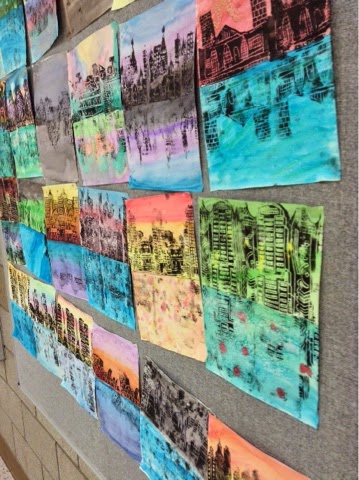
Reflecting Architectural Printing


We have been spending a lot of time this quarter drawing, printing and sculpting architectural structures. We started with our reflection watercolor prints of famous architectural wonders and then moved onto large-scale paper mache Gothic cathedrals. Photos to come soon!


Monday, March 2, 2015

Paper Mache Gothic-Inspired Cathedrals

Over the last couple of weeks we have been working on architecture design- drawing, printing and now over-sized paper mache relief sculptures. This was a feat for us since we only created 7 works, one on each table in the classroom (more about that later).

To begin we watched an amazing NOVA-produced video called the Building the Great Cathedrals. It was a perfect introduction to these engineering marvels. Students were then asked to draw a Gothic style cathedral using a shape tracing method shown in Deep Space Sparkle's Architecture Made Easy PDF. These drawings became our blueprints for how were were going to construct the cardboard and paper mache sculptures.

The plan was to have each table create a cathedral. That's right- one project per table...all day long. As each class came in for the day, whomever sits at that table would continue to add to that work. This was a challenge in itself; we worked the best we could with what was left after each block. However, this turned out to be a very successful large scale project challenge. Not only was it engaging but the transfer of skills from collaboration, to communication to just plain ol' perseverance was hard to ignore. Nice job 7th graders!


Friday, January 30, 2015

Graffiti Mola Names


7th graders started their quarter off with a project inspired by this Blick lesson as well as the work of Andrew McCormick's students. To introduce the idea of graffiti, we talked about street art (the ethics behind illegal and legal street art) as well as the idea of reverse graffiti and it's implications.

We also used many resources from http://graffitidiplomacy.com/ to help up along in our name designs. Value shading with colored pencil  and pattern design (with the metallic sticky paper in background) was a big focus of our work and reflected on our rubric.


These were a great first project to begin with since students names were so obviously drawn into the work. Hopefully they help me learn names faster this quarter! 

Check out this graffiti generator for ideas on how to get started drawing names in graffiti styles. 
Very cool!


Check out some of our finished work below...


Thursday, October 30, 2014

STEAM Collaboration- Periodic Table Sculpture


BMS students are so excited to begin this new STEAM-infused project happening this quarter! 


Overview of the project-
During Q2 and Q3, some STEAM classes (Science, Technology, Engineering, Art and Math) are planning a multi-grade, multi-subject Periodic Table sculpture project that will tie in with a mural being planned in the media center. The Periodic Table Sculpture will be a permanent piece of art for our building.
Students in 7th grade tech and science as well as 8th grade science and art students are all going to invest in parts of the planning, research and/or creation of the table sculpture.
In order to kick this off this multi-grade, multi-subject collaborative project, 7th and 8th grade students will be watching Nova's Hunting the Elements documentary this Friday afternoon.


Today in 8th grade art class, we are matching the 10 groups of the periodic table to our 10 material choices. Mirror, leather, granite, glass tile, shiny and burnished metal, Plexiglass, stone tile and two wood species will make up our giant table of elements sculpture. We'll be posting the results of the material survey soon. 

Monday, June 9, 2014

End of the year wrap up...


End of the year wrap up...Frank Big Bear portraits and CD mandalas.

Frank Big Bear portraits
For one of our last projects, we completed a colored pencil rendition of Frank Big Bear's unique portrait style. Value is highly stressed in this project as well as color schemes and how color effects artwork.

Our inspiration came from this great art ed blog post.
http://experimentsinarteducation.wordpress.com/2012/11/20/frank-big-bear/


CD Mandalas

With our mandala designs, we look at radial balance and repetition of pattern. CDs were designed with colored Sharpies and 3D paint, while the paper boarder was created with colored pencil and black marker.

This project was introduced with the contemporary art of Suzan Drummen.
http://www.thisiscolossal.com/2013/08/suzan-drummen/


Sci/Art Game Board Design

7th grade students end their science class with a review board game design. This quarter, we designed and created the games in art as a collaborative group project. We began this unit by looking at famous board games like Life, Candyland and Monopoly and what makes those games artistically well-designed.  We also focused on how important the element of line is in board games (and commercially produced printed toys in general). Sharpies, colored pencils, metallic sticky paper and of course, 3D puff paint were our media choices in this project. Game markers were made with Model Magic and Fimo clay.

Student games focused the five science and health units covered in 7th grade: Exploring & Classifying Life, Cells & Chemistry of Life, Reproduction & Heredity, Ecology, Human Body and Diseases.


Tuesday, May 27, 2014

Infographics in art class!

As a cumulative project for both science and art class this quarter, 7th grade students made infographics using the online creator, Piktochart. Each student was asked to choose a environmental science topic to research and use that information and data to show graphs, facts and illustrations within their infographic.

Piktochart.com allows students to create a free account and access a number of free templates to plan their work. We spent some time looking at what makes a strong infographic (such as contrasting font color on the background, layering images to create depth, etc) before actually sitting down at the computer. We also used some guiding questions/statements to help organize our work. 

Our three essential questions/statements: 
Why should we CARE? 
What can we do to HELP? 
We need to know MORE!


After we finished our work, we saved the infographics as jpeg files and turned them in through Edmodo.

Students examples: